Tuesday, February 13, 2007

Placoderm soft tissue preservation

The Late Devonian Gogo Formation is noteworthy for its exceptional preservation of fossils in limestone nodules -- particularly vertebrates. Amazing examples of nearly three-dimensional fossil fishes have been collected, showing life-like articulation. These fossil fishes have been exceptionally influential in our understanding of early vertebrate evolution, since they reveal such exceptional details. Now, Gogo is revealing new, unexpected details: the oldest soft tissue preservation in jawed vertebrates.

A recently published paper by Trinajstic et al. in the journal Biology Letters presents the details of muscles, blood vessels and individual neurons in an extinct type of early jawed fish, the placoderms. Unfortunately, the figures are, for the most part, less than dazzling. Nevertheless, here are some examples for your edification.


a) Shows an individual muscle fiber; b) individual neuron connecting to a muscle fibre; c) capillaries (blood vessels); d) calcium phosphate crystals that make up the preserved tissues.

One of the important discoveries in this paper helps us understand how the placoderms are related to modern fishes. Over the decades, numerous hypotheses have been offered for how all the various groups of jawed vertebrates were related to each other, particularly how the fossils fit in. Fossils, of course, give us essential clues to how evolutionary transformations have taken place, but it is first important to know how they are related to each other and modern forms. Placoderms have been proposed as the sister group of sharks and their kin, of bony vertebrates, or as the most "primitive" of the jawed vertebrates.

What some of these partially articulated placoderms show is the morphology of the actual muscle blocks of the body axis.


These will add much to the debate on how placoderms may be related to modern lineages of jawed fishes. The authors of the paper note certain similarities to lamprey in these muscle blocks, suggesting that placoderms were the most primitive jawed vertebrates. However, I'm going to leave my discussion of it there and leave it to the reader to investigate this question more fully.


Update 19/02/2007: As somebody in the comments asked: how did these tissues get preserved. Yes, of course! These days, I'm so wrapped up in phylogenetic analsysi work of my own that I totally forgot about other interesting science! Yes, how are these soft tissues actually preserved.

Well, the important thing to point out is that they've been phosphatized, just like the Doushanto embryos. No these are not "fresh meat" as Karl in the comments says. So this is this really analogous to the preserved dinosaur soft tissue, either.

The authors of the paper rely on palaeoenvironmental information about the site to infer that the conditions were in fact anoxic at the immediate site of tissue preservation. In the absence of oxygen, the calcium precipitated in the local environment would've preferentially been calcium phosphate rather than calcium carbonate (limestone). The presence of microbes on the surfaces of the cells served to concentrate the calcium phosphate precipipation in the place of the tissues. Remember, bacterial cells are much, much smaller than differentiated animal cells and so an entire colony of bacteria encasing an animal cell can effectively create a facsimilie of the original thing! However, my competence of the geochemistry involved in this type of preservation is quite limited and if you're interested in knowing more, I suggest looking into the process of soft tissue phosphatization for yourself.


Trinajstic, K. et al. (in press) Exceptional preservation of nerve and muscle tissues in Late Devonian placoderm fish and their evolutionary implications. Biology Letters. link
Read full post

Saturday, February 03, 2007

Not bad for only having read bits and pieces...

You know the Bible 56%!
 

Congratulations! You know a lot about the Bible - the books, the characters, the events. You are able to remember a lot of what you have heard and read!

Ultimate Bible Quiz
Create MySpace Quizzes


...but, perhaps I'll have to do a bit more reading. Perhaps not. I'd really like to see how my score stacks up to a lot of believers'. Zeno (score: 100%!) points out that a lot of non-believers know their bible as well or better than many believers. Granted, many non-believers are often 'de-converted' fundies who eventually emerged from their benighted state.

(Via Pharyngula.)
Read full post

Sunday, January 21, 2007

Where the fossils are

Today I had a rare opportunity to see something that gets most palaentologists excited. First, a little introduction. If you're not very familiar with finding fossils, you'll first need to know that fossils are found in sedimentary rock: the type of rock that is formed by deposited sediments (ie. sand, mud, or chemical precipitates). However, as any palaeontologist or amateur fossil collector will recount, you can search through vast amounts of sedimentary rock without ever finding a fossil. One can sift through tons of rock in some places and not find a single scrap of bone, or shell, or leaf of plant. On the other hand, there are places where one cannot take two steps without walking on fossils.

Fossil preservation can be a very selective thing. Some environments are more conducive to finding fossils than others. This week, I am in Wales where I had the oppotunity to visit some Early Devonian fossil sites (about 410 million years old) that are worked by a local amateur palaeontologist. At one of his sites, I pointed out some geological structure that explains the high quality of the material collected there, and the promise for more fossils. If you're out looking for fossils, this is where you want to look.

Take a look at the image below. It shows a sequence of sedimentary rock layers and shows a classic type of structure known as a channel form. Notice the two different rock types. The upper rock is a coarse material, with heavy bedding. It's base is tapered to the left forming what's normally called a "lense" or a "lenticular bed". Below it is a noticably different-textured rock. It's heavily cracked and broken up. It is mudstone.


Here's the same image with some guides.


In the mudstone below the massively bedded (typically coarse-grained, but not greatly in this case) is where the fossils are. This is one of the best types of sequences for finding fossils and, in large part, is where articulated fossil animals are to be found. It should be no surprise then, that this friend of mine has actually recovered quite a few articulated fossils from there. He became quite excited when I remarked that this is the ideal type of sedimentary sequence in which to find articulated fossils. So, let's hope, some exciting discoveries will come from this site.

Why do fossils preserve so well in these sequences? What are they? These deposits form in a river channel, and the image below shows quite nicely the lenticular shape of the channel.


What you can see is that there is deposition of sediments in one direction that partly causes the channel to migrate (concomitant erosion of the opposite bank is the other cause). In such settings, bodies of animals are buried very rapidly. Moreover, they are quite prone to flooding and the rapid deposition of sediments (that is often why the bedding above is massive, as it was filled in rapidly, rather than in progressive layering).

This is where the fossils are.
Read full post

Friday, September 29, 2006

Whence life began

Ooh! This is fun! An entire issue of Philosophical Transactions of the Royal Society dedicated to research on the origin of life. It covers everything from the prebiotic earth to the chemistry of replicators. I'm going to see how much of it I can read today and over the weekend and try to post some summaries. I'm no biochemist, so don't expect too much critical analysis, but origin of life stuff is a bit of a side hobby of mine. So hopefully I can say something meaningful. In the meantime, if you're keen enough to slog through some of this stuff, check it out!


01/10/06: Not going to get around to posting any summaries soon. There's a couple of conferences coming up, so preparing my talks and finishing a manuscript have taken priority. I'll try to get on it before I leave.
Read full post

Sunday, September 24, 2006

And now for something completely different

Since I've been really busy and this site has recently been devoid of much content of a biological character, I'm going to continue the trend. Here's an interesting homepage for an artist who examines the interface of advertising and western media and politics. I like it. I think his stuff has guts, humour, and isn't (in my opinion) overly pretentious. He's also my cousin and so I should plug his stuff. I particularly like this piece and this one.

Check out the site and enjoy!
Read full post

Anti-science vs. anti-evolution

I've grown to disapprove of the term "anti-evolution" to refer to the efforts of creationists to undermine education about evolution. I find it too vague a term, as it could also imply being against the actual process of evolution itself. Moreover, it masks the fact that the fundamental problem with creationism is not the fact that it is counter to a particular scientific theory (in this case evolution). Rather, the problem with the modern creationist movement is that it attempts to erode the honest, questioning, and disinterested process of investigation that gives us the best and most meaningful view of the world. There is no need for me to re-iterate the number of ways in which creationism is anti-scientific.

Because of this, I prefer to characterize this contemporary movement against evolution as that which it is: anti-science.

Creationists will frequently argue that it is not their facts that are different but merely their interpretation. Whereas the evolutionist assumes there is no god, the creationist assumes that there is and we just get a different result. This kind of thinking exemplifies the creationist misunderstanding of science. For they have no concept simply not assuming anything about god. For them, the fact that this independent and freely-thinking method of reasoning cannot discover gods and mysticism is a threat, because the world that it can discover did not discover one in agreement with their favourite scriptures.

For this reason, religious bodies have attacked science at nearly major turn in its history. Evolution is only the latest victim. But reproductive biology is already under heavy fire and it won't be long before the neurosciences and psychology are victims, too. The attack on evolution is only part of a larger pandemic of superstitious unreason. The people who attack evolutionary science fear it because it has been one of the most stark reminders that a literal reading of Genesis is incompatible with science. It is doubly unnerving for these people since it presents an altogether more convincing case, thoroughly modern in its expression, and based on the same principles of reasoning that have given us vaccines and rockets. People who oppose the teaching of evolution and who are disputing based on their egregious misunderstandings of the theory and deep-running ignorance of the facts are not simply opposed to evolution but to science in general.

However, as a minor semantic point alluded to at the beginning of this entry, the creationists aren't preventing evolution as a phenomenon (except socially). I would say they are trying to stymie that phenomenon known as science. Because of this, I think the semantic difference becomes important and the creationists are best referred to as "anti-scientists" and their activities as "anti-science". While their particular beef is with evolutionary theory, I'd say that referring to them as "anti-evolutionists" is too restrictive.

My problem is not their problem with evolution, it's with their bad methods, bad logic, bad evidence, and dishonest tactics. For that reason, I prefer not to call them anti-evolutionists but anti-scientists.
Read full post

Friday, August 11, 2006

Perfect neighbors

I saw this on Whyte Avenue in Edmonton... (click for a larger view).


Read full post

Wednesday, August 09, 2006

Fieldwork Pt II: Miguasha

There was once a time when there were very few animals living on the land. Vertebrates are pretty much the last animals to march onto land. The time before tetrapods is one of the most interesting for paleontologists and evolutionary biologists because it represents a time when the basic evolution of vertebrates is happening -- from their very origins to their two largest radiations: sarcopterygians ('lobe fins' - including ourselves) and ray-fins (all the most common fish we recognize today. Together, these two groups contain the vast majority of vertebrate diversity. It is also during this time that jaws originated and all kinds of appendages evolve into a diverse array of forms. If we are to single out the most significant site in helping us understand this time it is the greenish coloured cliffs of the Escuminac Formation at Miguasha, Quebec.

Located on the Baie des Chaleurs on the Gaspé Peninsula, the Parc Nationale de Miguasha preserves unbelievably beautiful and complete vertebrate fossils. The most famous of these is probably Eusthenopteron, the icon of children's books on prehistoric life as that fish that crawled from the water. While it is doubtful that Eusthenopteron crawled around on land, it certainly had much in common with the first tetrapods.

These are the cliffs from which it and many other extremely important fossil fishes were found.


I spent at least a few hours of every day, or sometimes the better part of a day out prospecting on the beach and the cliffs. Even with constant patrolling and daily visits by tourists, there are still important specimens to be found -- even lying on the beach. The most common fossil out there is probably the placoderm (or "armored fish") known as Bothriolepis. It's initial discovery was a serious case of "mistaken identity", as it was thought to be a turtle! However, later specimens from Miguasha showed preservation of its soft, unarmored body and tail demonstrating that it was a fish. Recently, a specimen was discovered showing stains on the inside of the ventral shield where the blood vessels had been!

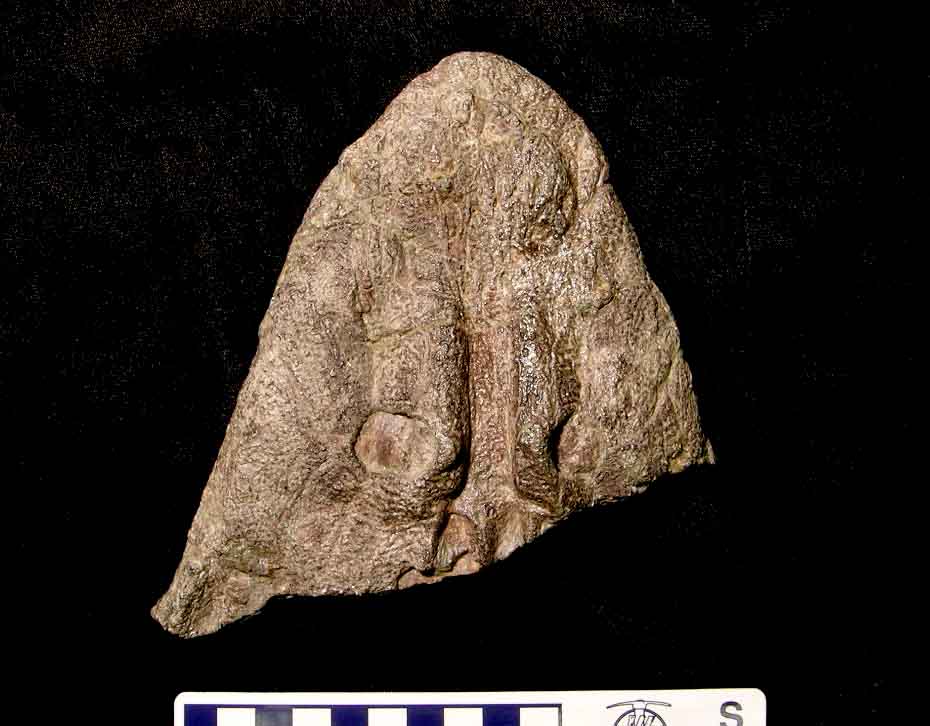
This same locality is also the place where Elpistostege, Tiktaalik's sister-taxon was first recovered. Elpistostege was really the first so-called "fishapod" to be found. Initially, only a partial skull roof was known and was described by T.S. Westoll in 1938. Since then, some more of the skull and body, seen below, have been found and described.


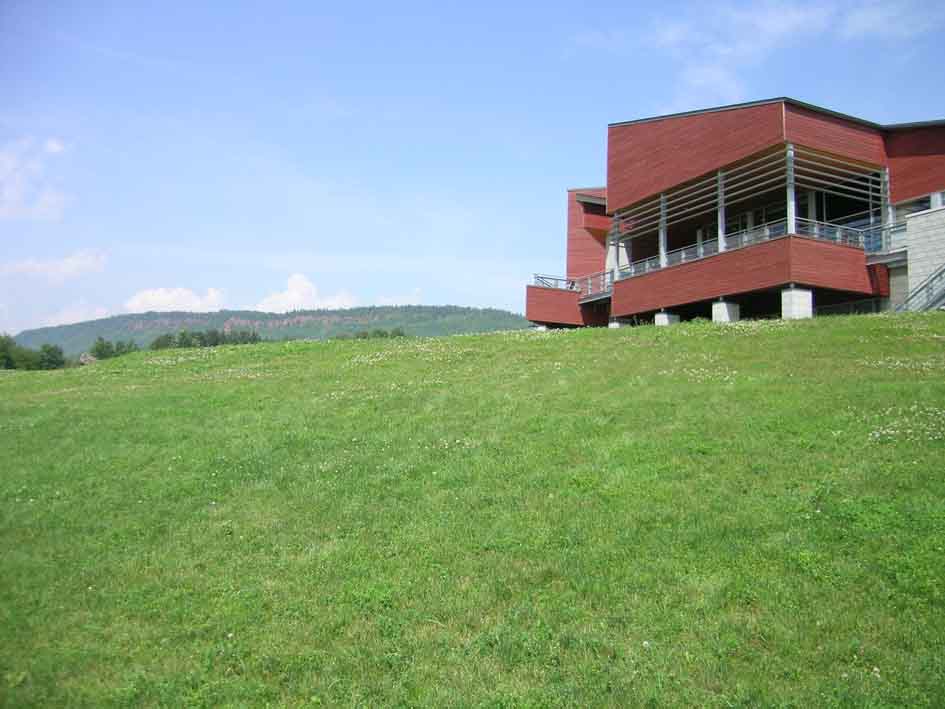
This is the beautiful museum which stands at the top of the cliffs. In my opinion, it probably has one of the finest displays of any museum in all of Canada -- and it's very small. The display is very pedagogical, in a good way. It uses the finest examples of each type of fish that is found at Miguasha to give the visitor a sense of the diversity that exists there. It uses a lot of pictures, specimens and cleverly organized displays to teach the history of the site: both geologically and in terms of the discovery, exploitation and research of the site. Sorry, I haven't got pictures of the displays handy.


In short, this bit of fieldwork was more like a holiday for me. In fact, it wasn't much in the way of fieldwork, since I got more work done in the collections. I really would like to encourage people to check the place out if they ever get the chance. It's a bit out of the way, but if you're at all interested in palaeontology, evolution, or just pretty places, it's well worth the visit.
Read full post

Monday, July 31, 2006

Fieldwork Pt I

Alas, an internet connection and a bit of time to explain my inexcusable absence from the blogging world! As some of you may know, my absence has been due to extended fieldwork missions in eastern Canada. My first project was in southern New Brunswick, collecting fossil fishes from the earliest part of the Carboniferous. The goal is to study the fish faunas that existed at that time and to understand how the vertebrate fauna turned over after the end of the Devonian. Of course, there is always the hope that one will find a tetrapod.

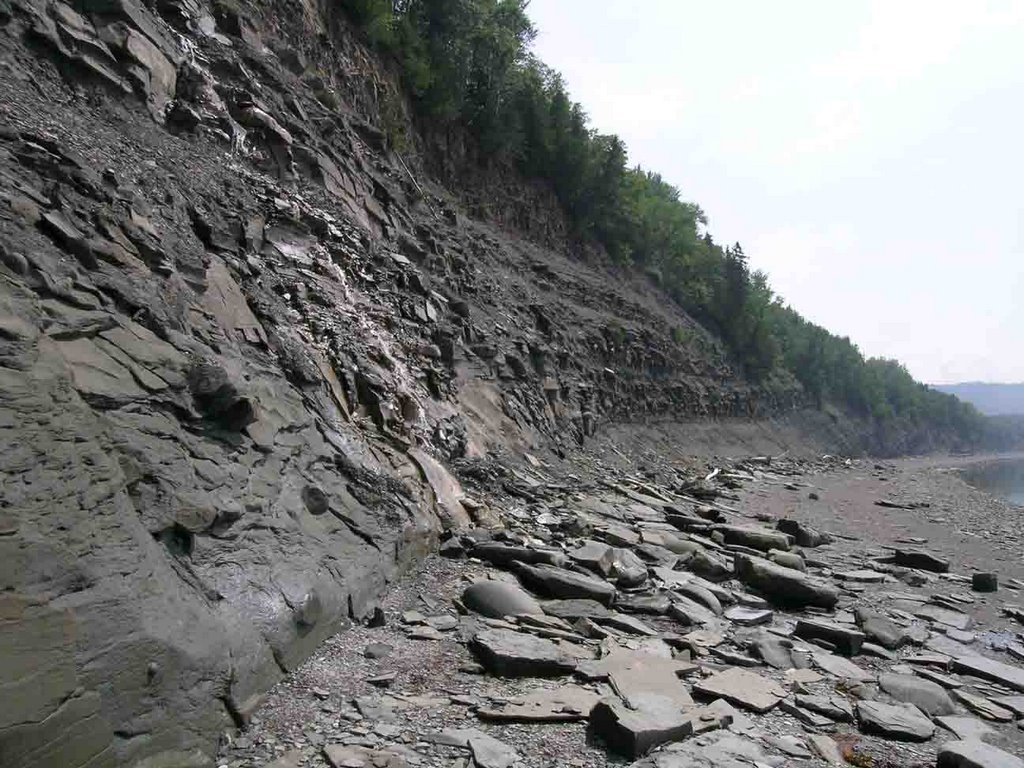
The site is relatively accessible and I'm not keen to inspire private collectors to poach the site, so my details will be limited. Most of the material is not really the envy of collectors as it is generally disarticulated, broken open in section, and ridiculously difficult to prepare. The fossils are found in shale beds that crop out in various parts of southern New Brunswick.

An outcrop of Carboniferous shale that is quite typical of the region. Fossil vertebrates appear to come from only a few restricted horizons in the formation.

The site is relatively rich and surprisingly more diversity is found here than we had previously expected from this fauna. Sadly, the tetrapod continues to elude us.


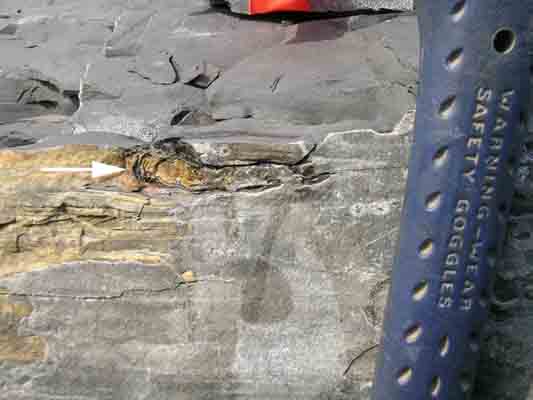
The partially articulated skeleton of an undetermined genus of lobe-finned fish is seen in section on the side of a large boulder.


Hopefully, the data from this work will help us understand both the diversity and paleoecology of vertebrates that lived shortly after the Devonian. This site has equivalent age counterparts all over the Atlantic provinces of Canada, each of which has different kinds of animals living in it. This could provide some information on how animals are distributed across different environments during this time which should be crucial in understanding what these ancient communities were like.
Read full post

Thursday, July 20, 2006

Fieldwork

In case you've been visiting and wondering why I haven't posted in so long, I've been in the field collecting fossils -- lots of fossils. I've had a very successful field season working on Early Carboniferous rocks in Atlantic Canada. I've been less successful with the Late Devonian outcrops, sadly, since there are so few of them. Since I've been camped out in what is essentially a cow pasture, I haven't had much time to post anything, but there will obviously be much coming up!
Read full post

Thursday, June 22, 2006

World's science academies against creationism

A lot of buzz about this. I didn't pay it much mind at first because a lot of scientific societies (even non-biological ones) have issued their statements against ID/creationism and for teaching evolution. But this one unites scientific societies from all over the world and has one of the single best statements I have seen:

"Scientific knowledge derives from a mode of inquiry into the nature of the universe that has been successful and of great consequence. Science focuses on (i) observing the natural world and (ii) formulating testable and refutable hypotheses to derive deeper explanations for observable phenomena. When evidence is sufficiently compelling, scientific theories are developed that account for and explain that evidence, and predict the likely structure or process of still unobserved phenomena."

-- IAP Statement on the Teaching of Evolution

That one elegant paragraph beautifully encompasses what is and what is not science, and cuts through to the very nature of science. The common creationist/IDist whine is that "macroevolution hasn't been observed, bla bla bla". Well, of course this is nonsense. This statement was evidently written by a people with their finger on the pulse of this issue. Well done!
Read full post

Wednesday, June 21, 2006

Mesomyzon, a Cretaceous lamprey

Fossil lampreys are exceedingly rare. The oldest are known from Early Carboniferous and that's about it. These fossils are recorded in limestones, suggesting that they were marine, while modern forms are known to inhabit marine and freshwater environments where they make their living parasitizing fish.

Today in Nature, Mee-mann Chang and colleagues report on a fossil lamprey from the same beds that have yielded feathered dinosaurs. Mesomyzon, figured below, is very similar to modern lampreys in many respects and helps bridge the, albeit rather small, morphological gap between the Carboniferous forms and modern forms. It also tells us that by the Early Cretaceous, lampreys had invaded freshwater habitats.

a, A complete fish (IVPP V14718A) in left view. b, Holotype (IVPP V14719) in right view. c, Drawing of the holotype, with the dorsal fin and caudal region reconstructed on the basis of IVPP V14718A. d, Photograph of head and anterior part of body of the holotype. e, Drawing of the same part as in d. Scale bars, 10 mm (a–c) and 5 mm (d, e). Abbreviations: a., anus; br.b., branchial basket; c.f., caudal fin; d.f., dorsal fin; d.t.?, possible digestive tract; g., gonads; g.a., gill arches; g.f., gill filaments; l., liver; l.e., left eye; l.ot., left otic capsule; ms., myosepta; nc., notochord; or.d., oral disk; p.c.?, possible piston cartilage; pc.c., pericardial cartilage; r.e., right eye; r.ot., right otic capsule. From Chang et al. 2006.


More about lampreys to come.


Chang, M.-m. et al. 2006. A lamprey from the Cretaceous Jehol biota of China. Nature 441: 972-974. <link>
Read full post

Friday, June 09, 2006

The pygmy giant: Europasaurus holgeri

Europasaurus holgeri is a pretty extraordinary animal. It is a sauropod dinosaur that would've barely stood taller than a man -- as an adult!. What's interesting about the discovery of this animal, is that the investigators decided to try to explain the size of this animal. Head over to the Palaeoblog and check it out.

There were a number of interesting papers in this week's Nature and I simply haven't had time to cover them or use them in some way. I'm on it! I'm on it! Just give me some time!
Read full post

Thursday, June 08, 2006

A little something about scientific publishing

Manuscripts sent to journals get rejected all the time. It's no surprise, since it's unlikely that journals could even publish everything that's sent to them... okay, maybe some could. However, I just had a really frustrating experience: an editor who decided to make up his own reasons for rejecting the paper.

Despite favourable reviews from two referees, this editor claimed that our manuscript had previously been submitted to and rejected by another journal and that we didn't even bother to send a clean copy, just a re-formatted manuscript! Of course, my co-author and I have never submitted anything in our careers to that other journal! Thus, it does not appear that this editor even bothered sending any emails to check his facts, as there should've been no ambiguity.

I'm expecting an apology from the editors any day now. I don't care if they can reject it on scientific grounds, but to make up such an offensive charge is academically irresponsible and shows brazen indifference. I'm not even expecting them to re-consider the manuscript, as I'm not sure I want to publish in that journal anymore. This has left me seriously dismayed with the quality of editorship there. If they don't apologize to us, I may well fill in the blanks here with names.
Read full post

Wednesday, June 07, 2006

Oh crap...

I don't cover a lot of politics, mainly because I'm Canadian and a lot of my readers are from elsewhere. However, this burns my ass. How does one manage to accidentally pass a budget? A conservative budget at that! This is going to be a scary year, folks!

(Hat tip to Orange Juice -- who is now appearing in my blogroll, by the way. If you're up on Canuck politics, go say 'hi'.)
Read full post

Thursday, May 11, 2006

A little more Tiktaalik...

...just for good measure.

Neil Shubin, one of the discoverers of Tiktaalik roseae has an essay online about the discovery, a bit about its history and why it's significant.

Tiktaalik would appear to be the only fossil with its own homepage, check it out.
Read full post

Sunday, May 07, 2006

My letter to The Dispatch.

I responded to Mark Looy's (of AiG) letter to the Columbus Dispatch, it was published today. Many thanks goes to the editors of the Dispatch for having the integrity to publish a response to the misinformation spread by Looy.
Read full post

Just entertainment?

"Psychics" really are scum. Onegoodmove has the video.

These so-called psychics are a bunch of bozos that prey on the emotional fragility that each and every one of us has to face at some point in our lives.
Read full post

Thursday, May 04, 2006

The "other end" of the fish-tetrapod transition

I guess one can't really talk about an evolution transition having 'ends', since one might even consider the origin of vertebrates as a whole to be part of the origin of tetrapods story. However, we focus a lot on the transformation from sarcopterygian (lobe-finned) fishes to the earliest tetrapods like Acanthostega and Ichthyostega. Lest we forget the origin of the sarcopterygians themselves. This is a murky and poorly understood part of vertebrate evolution where the fossils are limited to what we affectionately call "thumbnail skulls". These are usually braincases and associated snouts that aren't much bigger than, well, your thumbnail (and kind of shaped like them too).

In recent years, we have seen the publication of a number of really peculiar thumbnail skulls from China, nearly all of which belong to some kind of sarcopterygian. One of the defining features of the sarcopterygian skull is a joint that runs right through the braincase. The only living sarcopt to retain such a feature is the modern coelacanth. However, once upon a time in the Devonian, most sarcopterygians were built this way. We know these skulls are sarcopterygian because of this division of the skull and braincase, as well as the histology of the dermal bone. Sarcopterygians are unique in having had a system of pores and canals running through an enamel-like layer on the outside. This tissue matrix is called cosmine. One will often hear of "cosmine-covered osteolepiforms" or "cosmine covered sarcopterygians", to distinguish these forms from taxa that later lose cosmine (for instance, the loss of cosmine is a character that Tiktaalik shares with tetrapods).

But apart from these defining features of sarcopterygians, the thumbnail skulls from China also have a strange mélange of characters from all kinds of other fish groups: actinopterygian (ray-finned) fishes, sharks, placoderms, and acanthodians. For instance, it was recently noted that several of these taxa had the bony facet for the attachment of an eyestalk -- a cartilage rod found in some modern sharks that supports the eyeball. Similar facets have been seen in fossil shark braincases and later in ray-finned fish braincases. Psarolepis, for instance, was shown to have a cheek very similar to that of an actinopterygian and it even had a spine on a shoulder girdle that was associated with the skull. The actual identity of some of these parts, however, may be disputed because we still haven't got whole skeletons of these fishes.

Today in Nature a new piece is added to this puzzle: Meemannia eos. This new taxon is peculiar as far as sarcopts go. It has something sort of like cosmine, but somewhat more rudimentary. However, another interesting aspect is the absence of an intracranial joint, like the one described above.
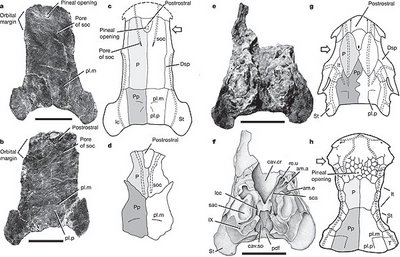
This 405-Myr-old fish shows a mixture of basal actinopterygian and sarcopterygian features. a, b, Dorsal view of skull roof (a, holotype, V14536.1; b, V14536.2). e, f, Ventral view of posterior portion of the skull roof with incompletely preserved oto-occipital structures (e, V14536.4; f, illustrative drawing). c, d, g, h, Reconstruction of skull roof (c) compared with two actinopterygians, Dialipina (d) and Cheirolepis (g), and one sarcopterygian, Powichthys (h). Abbreviations: am.a, am.e, anterior and external ampullae; cav.cr, cranial cavity; cav.so, supraotic cavity; Dsp, dermosphenotic; It, intertemporal; lc, otic portion of the main lateral line canal; lcc, lateral cranial canal; P, parietal; pdf, posterior dorsal fontanelle; pl.m, pl.p, middle and posterior pit-lines; Pp, postparietal; re.u, utricular recess; sac, sacculus; sca, anterior semicircular canal; soc, supraorbital canal; St, supratemporal; T, tabular; IX, exit of the ninth cranial nerve. Open arrow in c, g and h indicates the position of the orbit. Scale bar, 5 mm (a, b, e, f). From Zhu et al. 2006.


Immediately, one is faced with two options: was the joint lost or was it simply primtive? The answer appears to be the latter, and that Meemannia is the most primitive sarcopterygian known to date. The skull roofing bones of Meemannia are curiously similar to those of primitive ray-finned fishes. In fact, the authors note, the snout appears to have been loosely attached to the rest of the skull, a feature also seen in placoderms. The weight of the evidence appears to support the conclusion that Meemannia is a rather 'primitive' animal.
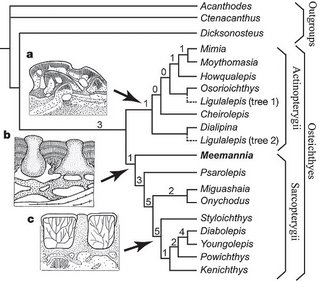
The figure is based on two most parsimonious trees that differ in the positions of Ligulalepis. Bremer support values are shown at nodes. Tree length 222, consistency index 0.6216, homoplasy index 0.3784, retention index 0.7807, rescaled consistency index 0.4853. See Supplementary Information for details. Insets compare the histological features of Meemannia (b) with those found in actinopterygians (Andreolepis, a) and crown-group sarcopterygians (Porolepis, c). From Zhu et al. 2006


Furthermore, I mentioned that it had cosmine or something very much like it. The authors note that what we see in Meemannia the cosmine structure is unique among sarcopterygians and offers some clues about its natural history. In previous decades, the pore-canals have been suggested to represent a system something like the ampullae of Lorenzini in sharks. This is a network of electrosensory organs that sharks have spread over their faces, and the networks of the ampullae are quite similar to that seen in cosmine. Of course, cosmine-covered sarcopterygians are all extinct and we have no way of knowing what the function of the cosmine canals and pores were for. However, the new fossil suggests a rather different function: growth. Unlike the cosmine of other sarcopterygians, but somewhat like the enamel tissue of actinopterygians, the cosmine of Meemannia grew by the addition and expansion of layers. This suggests that Meemannia's cosmine growth is more primitive. Furthermore, this unique mode of growth suggests that he pore-canals may be a vascular system that supprted this, and may not necessarily have been for sensory purposes. However, I don't see these options as neccessarily exclusive, so I'm not sure if we can really rule out a sensory function just yet.

Meemannia is another addition to the story of the early evolution of bony vertebrates. It's another clue about how this event proceeded and how the two major lineages of bony vertebrates emerged. We still need a lot more clues and a lot more work to figure out the details, but the fossils from China are (once again) helping to disperse the fog.


Also worth a mention here is that Meemannia eos is named after the renowned vertebrate palaeontologist Chang Mee-mann for her enormous contribution to vertebrate palaeontology, especially in China. Her influence on palaeoichthyology has been enormous and she is easily one of the most respected contributers to the field of early vertebrate and early fish evolution.


Zhu, M. et al. 2006. A primitive fish provides key characters bearing on deep osteichthyan phylogeny. Nature 441: 77-80. <link>

See also:

Basden, A.M. et al. 2000. The most primitive osteichthyan braincase? Nature 403: 185-188. <link>

Zhu, M. et al. 1999. A primitive fossil fish sheds light on the origin of bony fishes. Nature 397: 607–610. <link>

Zhu, M. et al. 2001. A primitive sarcopterygian fish with an eyestalk. Nature 410: 81–84. <link>
Read full post

Thursday, April 20, 2006

The serpent beguiles?

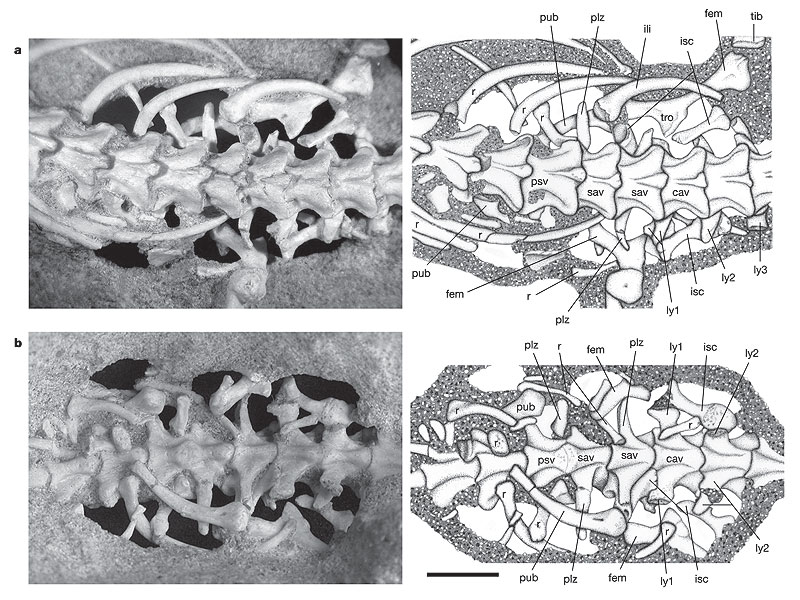
More blasted intermediates to deny today. This hasn't been a good month to be a creationist. Najash rionegrina from the Late Cretaceous of Patagonia is no ordinary snake: it has legs.


This is not the first fossil snake with legs to be found. Previously, there had been Pachyrhachis, Haasiophis and Eupodophis. What's especially interesting about Najash is the presence of a sacrum: usually a modified rib that forms a strut between the vertebral column and the pelvis and helps support the body on land. This is a feature that is found even in the earliest tetrapods and tends only to be lost when limbs are lost or when tetrapods become more fully acquatic.

The authors analyzed the characters of various snakes (fossil and living) and generated the following tree:


The interesting thing to note is that Najash is the most primitive snake. However, the other three legged snakes find themselves deep inside snakes. In fact, they're what are known as the Macrostomata, the group that includes the things you most commonly refer to as modern snakes: boas, pythons, as well as the more derived vipers and the elapids (cobras and their kin).

Now, the last thing I want to get myself into is the sordid debate on snake origins. This new hypothesis will not go without contention since it requires several independent losses of limbs or even the independent re-development of limbs in order to account for the distribution. The debate on snake origins is a hot topic and the key players show no mercy with each other! So, I'll try to ride the fence here.

This phylogeny lies at the heart of the debate on snake origins. One issue here centers on whether or not the mosasauroids (large, extinct marine lizards) are the sister group of snakes and whether or not snakes have a marine origin. The mosasauroids (which includes the mosasaurs proper, as well as the smaller aigialosaurs) are not likely to include the ancestor of snakes, but they share a lot of features in common, such as body elongation and the way the teeth fit into sockets in the jaws -- a condition called "thecodonty" (tooth in hole). In other varanoid lizards (like the Komodo Dragon), the base of the tooth is sort of "squished" to the inside of the jaw, a condition called "pleurodonty" (see a diagram of these tooth types here).

Interestingly, however, a lower jaw referred to Najash apprears to present a pleurodont type condition, or something very similar. This means that the pleurodont condition might actually be ancestral for snakes, and therefore the condition seen in mosasauroids might have nothing to do with the condition seen in snakes.

A matter of outgroup:

The dichotomy that arises between a mosasauroid vs. 'other' sister-group hypothesis is also one between a terrestrial origin for snakes and a marine or aquatic origin. Najash is apparently a terrestrial snake and, in its position as the most 'primitive' snake of all would suggest that terrestriality is ancestral for snakes. But all of this is dependent on how we interpret their tree. This, of course, is further dependent on how the authors treat the data.

One of the potential problems with this new work is that it doesn't actually test the question of who is most closely related to the snakes. If you look at the tree they've obtained, one can see the most deeply stemming branch is labeled "Varanoid root". This is the outgroup, the taxon in the analysis against which allows the analysis to infer the "direction" of evolution inside the tree. The authors constructed a hypothetical varanoid from observations of different varanoids, including mosasauroids. However, since it's only a single terminal taxon, it is impossible for snakes as a total group to "move around" in the analysis. They're stuck there next to a hypothetical taxon. So, the question of mosasauroid relationships is unaddressed. Furthermore, the different outgroup will have different characters, resulting in

The other (and somewhat related) argument that may fall under contention is the inference of the ancestral condition for snakes as a whole based on the environment of Najash. This may be somewhat problematic, especially where they have the other snakes with legs higher up in the tree. If, instead, the other snakes with legs are more primitive (as one would initially think), and one were to test whether or not there is a marine outgroup, then terrestriality might be a specilaization of Najash rather than an ancestral feature. The placement of the legged snakes within the macrostomatans has been contested int he past and will continue to be, so watch for that!

The take-home message here is actually me 'busting down' the sacrosanctitiy of the concept of 'transitional forms'. Najash is almost certainly intermediate and, at this time, I hardly doubt that it is the most primitive snake. As such, it tells us about the early origins of snakes. But it is not an ancestor, and even as an approximation of an ancestor, it is still specialized in its own way. The same could be said for Tiktaalik which has its own specializations that are not necessarily intermediate between other fishes and tetrapods.

The other thing to bear in mind is that perhaps our problem with the re-elaboration of limbs is fraught with 'common sense' thinking -- often a danger in science. It is difficult to imagine how snakes could simple re-evolve their legs, but it would be unwise to use such an argument. The development of an embryo is a hierarchical process and all or most of the genes used in 'leg-making' in snakes probably never disappear (though perhaps somebody more up to speed on this could comment here). A few or a single 'up-stream' switch in the hierarchy of development could perhaps turn the whole leg on or off. Our personal preference or bias that snakes should not 'grow back' their legs must not be an argument. More robust phylogenetic arguments as well as developmental biology should be looked to for clues.

The goal of the study of phylogeny is to sort out between three different kinds of characters: those that are ancestral and therefore ancient and general (plesiomorphy), those that are specialized and unique to a taxon (autapomorphy), and those that are the characteristics unique to a group that shares a unique common ancestor (synapomorphy). When we have sorted out the best and most heavily tested solution to this trichotomy, we can then infer what is the ancestral state. The data on the fish-tetrapod transition are so unequivocal that it is pretty easy to sort this out for Tiktaalik. The same can't yet be said for the origin of snakes, and Najash is by no means the last word. We'll be hearing a lot more about this soon.


Other blogs:
Pharyngula


Apesteguía, S. and Zaher, H. 2006. A Cretaceous terrestrial snake with robust hindlimbs and a sacrum. Nature 440: 1037-1040. <link>
Read full post